Leading & Building a Global B2B Experience
CASE STUDIES
Team composition
Senior UX designers | Product Owner | Digital Director | Developers | German Project Manager
My role
Owned the B2B UX strategy and delivery.
Defined MVP and drove prioritisation.
Led research, design & validation of key flows.
Aligned stakeholders and teams across markets.
Championed scalable, user-centered solutions.

Context
BMI aimed to unify and globalise its B2B offering, leveraging insights from established platforms in Poland and Sweden to define a scalable solution.
The German market was prioritised as a high-impact but complex pilot, given its low digital maturity and stakeholder concerns around adoption.
Challenges
🚩 Limited customer access
🚩 Customer readiness of the platform
🚩 Difficulties to follow the Agile methodology
🚩 High Development Cost
RESEARCH
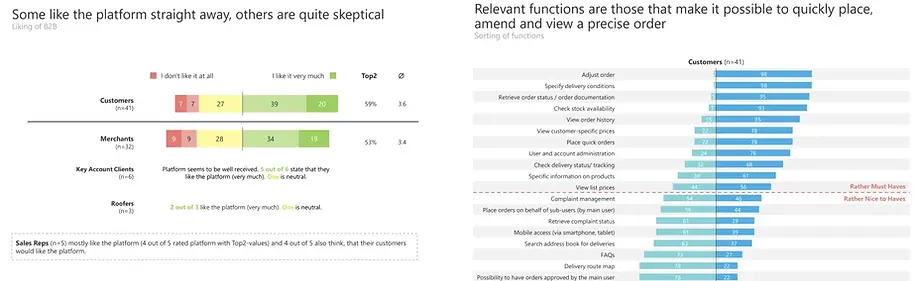
German User Interviews
Following the UX audit and data analysis, the German team decided to engage with customers before initiating the project.
🕵
50 customers
🖥️
Desktop view
⏱️
45 minutes
🔍
Features based
➡️ Assess market readiness for digital ordering, including concerns around customer adoption and merchant relationships.
➡️ Define MVP feature requirements based on user needs, business constraints, and cross-market insights (Poland & Sweden).
➡️ Identify key drivers and barriers to adoption to inform rollout strategy.
➡️ Align business, operational, and technical constraints (e.g. SAP integration) to ensure feasibility and scalability.
.webp)
RESEARCH
User Personas

Problem
The current ordering process is fragmented, manual, and inefficient, relying on fax, PDFs, and phone calls, making it difficult for both customers and internal teams to place, manage, and track orders.
How might we design a scalable digital ordering experience that replaces manual processes while ensuring adoption, aligning with business constraints, and supporting both customers and internal teams?
.webp)
TEAM MANAGEMENT
UX/UI RoadMap
To bring clarity and alignment across the team, I created a roadmap that mapped out feature development, sprint planning, and designer availability.
This gave the Product Owner and stakeholders clear visibility on progress and priorities.
I continuously updated the roadmap to keep everyone aligned and ensure we successfully met the November launch deadline.
.webp)
TEAM MANAGEMENT
All hands on deck
While managing other products, I relied on Senior UX Designer Yuliia to lead the early phase of this project. She collaborated with German stakeholders to create a Service Blueprint and define key user flows, which were validated early to ensure technical feasibility and minimise rework.
Using a feature-based approach, I structured and refined the roadmap, gathering detailed requirements and aligning them across markets to support scalability. Each feature was backed by research, with the goal of delivering and testing fully designed end-to-end flows.
.webp)
.webp)
IDEATE
UI Experiments
Together with Yuliia, we applied the BMI Design System to maintain consistency, reusing and adapting components to fit B2B needs.
During this time, we worked closely with the tech team to understand SAP, discuss design ideas, and assess development feasibility. This helped us create the best solution while keeping development time efficient.
🚨 New and complex user flows
🚨 SAP integration constraints
🚨 Tight design timelines


TESTING
Moderate User Testing
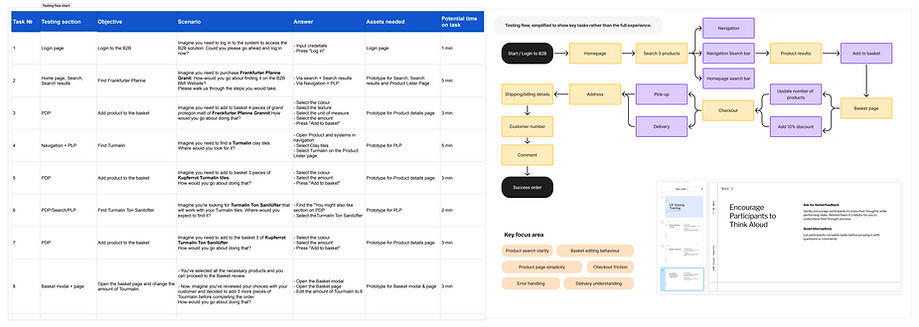
We led a moderated usability test with Yuliia, using a high-fidelity German prototype with real data.
She prepared the test plan, script, facilitation guidelines for German-speaking stakeholders, and captured key insights.
🕵
10 customers
🖥️
Desktop view
⏱️
45 minutes
🖥️
Ordering flow
GOAL: Identify potential obstacles or areas of confusion in the order process , with the ultimate goal of enhancing customer satisfaction and streamlining the purchasing experience.
TESTING
Results & User Insights
The test results were very positive overall. Users suggested a number of small improvements, often mentioned by only one participant. We will keep them in a future improvements file and focus on the following:
4/10
users
Express missing information on Checkout
customers noted missing freight and pallet costs details in checkout.
4/10
users
Report needing a summary page
customers requested a checkout summary before the "Thank You" page
3/10
users
Want building site or warehouse address
needed clearer address differentiation for the Delivery shipping method.
"Ich bin mit dem Gesamtablauf der Einkaufsänderung sehr zufrieden. Ich habe derzeit keine Verbesserungsvorschläge."
"I am very satisfied with the overall process of the purchasing. I currently have no suggestions for improvement."
Customer’s comment on Pick up flow

FINAL UI & SPECS
Ready for Developement & QA handover
Design Delivery
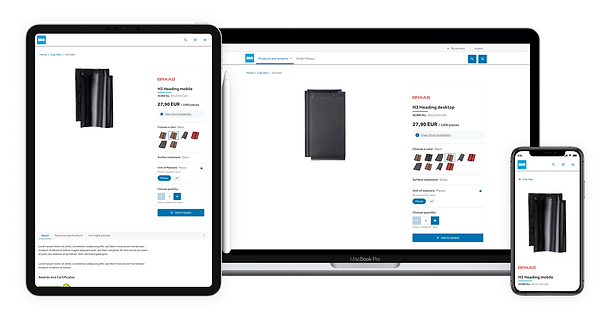
➡️ Delivered responsive mock-ups (desktop to mobile)
➡️ Defined behaviour specs and UI anatomy
➡️ Contributed to a reusable component library
➡️ Built an interactive prototype covering key flows (stakeholder alignment & QA)
Collaboration & Quality
➡️ Aligned with developers to review flows and validate feasibility
➡️ Clarified interactions and identified gaps before build
➡️ Joined stand-ups to stay in sync with delivery
➡️ Led design demos and supported QA to ensure UI quality and consistency



Successes
🚀 Successful Soft Launch
Strong early engagement from selected customers.
🧩 Scalable Design System
User-tested components added to the BMI library.
💬 Positive Early Feedback
Improved usability and clearer ordering flows.
🧑💻 Team Delivery
➡️ Led 2 designers to deliver the full journey.
➡️ Prioritised smartly to unlock faster delivery.
➡️ Enabled strong collaboration across teams.
👷 Team Growth
➡️ Mentored and up-skilled a mid-weight designer
➡️ Built confidence in testing and collaboration.
➡️ Encouraged a learning mindset.
🌱 UX Impact
➡️ Raised UX visibility across the business.
➡️ Drove best practices and knowledge sharing.
➡️ Positioned design as a strategic partner.

Challenges
Stakeholder alignment vs user needs
Balancing expectations while defining a clear MVP.
Changing scope
Managing frequent scope changes despite agreed features
Technical constraints
Designing within SAP limitations
🚀 Next Steps
Scale to new markets
Adapt the product to country-specific needs.
Collect user feedback
Continuously improve the journey post-launch.
Expand rollout
Move from soft launch to national rollout.
